|

14-Days Summer 2012
Experience Peru through Cultural Immersion
Machu Picchu, The Sacred Urubamba Valley, Olltaytambo Village then to Lake Titicaca
Please review the information below, and contact
us anytime you have additional questions.

Our program includes six components:
- Daily activities
- Service Projects
- Group Hikes
- Solo Experiences
Daily Activities
These activities are a sample of what is available during your
stay at in Peru. Each participant will have an opportunity
to work at of the local shops or projects and participate in
the different activities throughout their stay in Ollantaytambo:
Quechua and Spanish language Learning. Conversational language
learning in the cultural immersion tradition, allows the participant
to learn by doing, not by translating. You will learn the language
with locals to acquire a better understanding of your Peruvian
surroundings.
 Service Projects Service Projects
- Adobe making, house roofing and field work.
- River and Inca
Path Cleanup
- Tree Planting Campaign are service
programs in the area.
Visiting
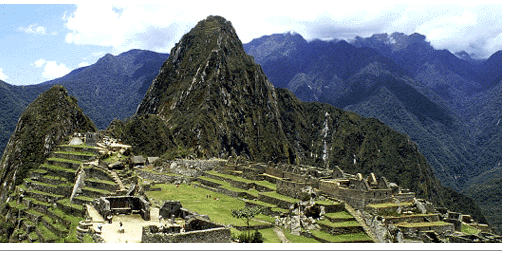
Important Historical Sites - Trek Along a Portion of the Inca Trail to Machu Picchu
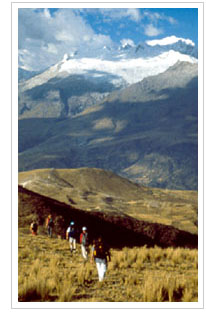 We will visit many of the amazing important ruins in the
area. Inca Trail section: Participants will disembark the Machu
Picchu train at Kilometer Marker 104 and hike, with both an
MSI and local guide, on a branch of the Inca Trail to the formidable
complex of Winaywayna. This links up with the Inca Trail to
Machu Picchu. The rest of the day will be devoted to visiting
the famed and stunning ruins of Machu Picchu. We will visit many of the amazing important ruins in the
area. Inca Trail section: Participants will disembark the Machu
Picchu train at Kilometer Marker 104 and hike, with both an
MSI and local guide, on a branch of the Inca Trail to the formidable
complex of Winaywayna. This links up with the Inca Trail to
Machu Picchu. The rest of the day will be devoted to visiting
the famed and stunning ruins of Machu Picchu.
Quechua - Indigenous Elders Speak
You will learn village Elders’ perspectives of their
place in the world and how Inca and Quechua culture relate to
the Pacha Mama or Earth Mother, and may, if you wish, participate
in ceremony and prayer honoring the Pacha Mama and Mountain
Spirits or Apus in the area
Lake Titicaca - (Lake of the "Silver Puma Waters")
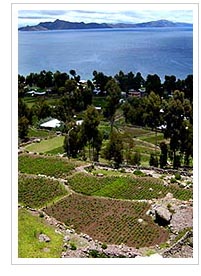 Lake Titicaca is 12,530 feet above sea level and is the second largest lake of South Americacovering some 3200 square miles. Twenty four miles to east of the Peruvian town of Puno, in the middle of Lake Titicaca, lies the Island of Amantani, reachable by a 3-4 hour boat ride across the lake. The island is about 15 square kilometers with about 3,663 inhabitants. Its population is Aimara and is dedicated to the agriculture on the island. The ancestral customs of their residents, the way of life and landscapes, make for a culturally rich visit. The handmade works carried out in textile; ceramic and furrier are magnificent. The residents of the island have the traditional celebration of Santiago's Feast during the month of July. Amantani Island also holds important archaeological remains belonging to the Inca and Tiahuanaco's culture. Lake Titicaca is 12,530 feet above sea level and is the second largest lake of South Americacovering some 3200 square miles. Twenty four miles to east of the Peruvian town of Puno, in the middle of Lake Titicaca, lies the Island of Amantani, reachable by a 3-4 hour boat ride across the lake. The island is about 15 square kilometers with about 3,663 inhabitants. Its population is Aimara and is dedicated to the agriculture on the island. The ancestral customs of their residents, the way of life and landscapes, make for a culturally rich visit. The handmade works carried out in textile; ceramic and furrier are magnificent. The residents of the island have the traditional celebration of Santiago's Feast during the month of July. Amantani Island also holds important archaeological remains belonging to the Inca and Tiahuanaco's culture.
Hosts Segundino Cari and family own the Kantuta Lodge on the shores of Lake Titicaca. This lodge, serves as our basecamp for cultural immersion, service learning, mini-solos, leaning of sustainable farming and weaving, and for hikes to the Pacha Mama and Tata, or Earth Mother and Father Ruins on the two summits of Amantani, used for time immemorial for annual ceremonies honoring the earth and what she provides.
Return to Top of Page

R. Richards
'Randy' Richards has guided and taught individuals, clients,
and participants throughout South America, the European Alps
and the Western US since 1981. He has been a senior guide for
Alpine Ascents International on Aconcagua, Argentina and four
of Ecuador’s major volcanoes, and expedition co-leader
on Mt. Huascaran, Peru, as well as a respected instructor on
Mt. Baker...read more.
Richard Cari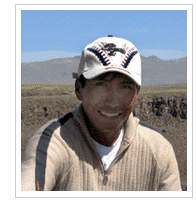
Richard and his parents Sigundino and Marcelina Cari, own the Kantuta Lodge on the Island of Amantani on Lake Titicaca, Peru. Richard is a graduate of the Puno University and studied tourism and hospitality. Since graduating from the University, Richard and his family have been improving the family lodge which lies just meters from the shores of Titicaca. Sigundino is a former town official and assistant to the head shaman on the island. Richard Speaks Spanish, Quechua, English and Aymara.
Return to Top of Page

Mountain Spirit suggests that you purchase a few guide books
from our reading list, brush up on your languages, and start studying!
Please contact us for our reading list.
Visit www.cdc.gov
for details.
Health
Your MSI staff on this program includes Randy
Richards, an Emergency Medical Technician, to take care
of you while you're with us. Before you leave, however, The
Center for Disease Control CDC recommends the following vaccines;
see your doctor at least 4–6 weeks before your trip to
allow time for immunizations to take effect.
- Hepatitis A or immune globulin (IG).
- Hepatitis B, if you might be exposed to blood (for example,
health-care workers), have sexual contact with the local population,
stay >6 months in the region, or be exposed through medical
treatment.
- Yellow fever vaccination, if you will be traveling outside
urban areas.
- As needed, booster doses for tetanus-diphtheria and measles.
- Anti-malarial drugs are not necessary for this trip (per
MSI).
For more information on CDC recommendations, please visit their
web
site.
Our Peru expedition will include hiking and camping at high
altitudes; for this reason, you should be healthy and fit enough
to endure the hiking/camping portions of our program.
Supplies and Belongings
Come prepared with an open mind, bring a journal, and if you
like to draw or watercolor, this is the program for you. Wendy
Weeks, your host at El Alberque, is an accomplished painter.
As a result, oils, watercolor as well as other mediums could
be as important as your camera, so bring some art materials.
There are people who have traveled for ten years in Peru and
never had anything stolen. There are others who have traveled
for one month and have had things taken from them ten times.
One can very easily take precautions. We recommend reading Lonely
Planet’s instructions about traveling safely.
You can purchase most everything in Cusco that you'll need
(shampoo, razors, socks and t-shirts, etc.), so you may want
to buy some of these items there. Certainly, traveling light
on the plane and buying a sweater in Cusco is a good way to
go. However Gore-tex or similar rainwear is better purchased
in the US. Consider also purchasing a large colorful Peruvian
duffle bag once you are there for taking gifts back to the US.
In short, pack for hiking and camping, as well as relaxing.
For suggestions on what to bring along with you, please contact
us and we'll be happy to help.
 Language Language
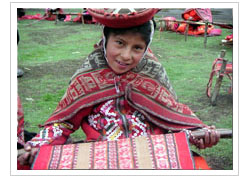
We ask that you study the language before you go. A bit of
effort to speak the language goes a long, long way with the
local people. We can’t emphasize this enough. Knowing some
basic Spanish and a few Quechua words will do more than anything
else to put you in closer touch with the people of Peru. Learning
the basics is easier than you might expect. Start with Spanish
tapes or a fun picture book with removable stickers of Spanish
words (which one can put on light switches, night tables, and
toothbrush).
Randy speaks fluent Spanish and basic phrases in Quechua. The
other staff speaks fluent Spanish, as well as Quechua and English.
Some shop owners may speak a little English. If you find yourself
in a bind, you probably won’t have a long wait before someone
comes to your rescue. However, our expectation is that you will
have learned some basic Spanish prior to our expedition, as
a courtesy to your hosts.
Return to Top of Page

Altitude
Taking it slowly the first few days to allow time for your
body to acclimate is the most important rule for adjusting to
altitude. By the time we embark on any significant hiking or
climbing, you will be fairly well adjusted to the altitude.
Your guides and facilitators will use the old program of 'climbing
high and sleeping low' to properly acclimate. Cusco is at 3362
Meters (about 9500 ft.) and higher than Machu Picchu, so one
should plan on taking it a bit easy the first day.
Money, Credit Cards and Debit Cards
Cash advances and debit machines are easily accessed in Cusco
and Lima, however we have found that VISA is much more widely
used than Mastercard. Have a backup card carried in a separate
place. Transfers from Savings to your checking is also possible
in some locations but not all. Traveler’s checks may be
cashed at some locations.
Communications
- PHONE: having a calling card will be useful or better yet,
you can purchase a Peruvian calling card and use it for calling
the US.
- EMAIL: This is the best way to go. There are public computer
booths/stalls where you can log onto the web for approx. $.50/hour.
Having a web-based email such as Yahoo! or Hotmail is free,
so you only pay the hourly rate. It can save a bundle on phone
calls.
- MAIL: Peruvian stamps aren’t the cheapest but are works
for art. Regular mail’s reliability has improved somewhat,
especially for letters, which take about 2-3.5 weeks in delivery
time. Mailing valuables, and any packages for that matter, is
not recommended.
- FAX: easily available, but more expensive than email, in many
shops in town.
- SKYPE INTERNET CALLING:
Web- based program available at all internet booths that allows free high quality intenational calling and video calling to and from Internet café computers. Simply create your own account and open it on any computer to start calling other Skype users or regular telephones for about .02 cents per minute
Return to Top of Page

Our 2009, 14-day Peru Program is limited to 5 people and costs $2800.00.
International and in-Peru air travel is not included.
(US and in-Peru air costs are estimated at Estimate $900.00 - 1000.00, based
on rates provided on the internet Sept 2012 for roundtrip airfare for BOS/LIMA/BOS
and LIMA/CUSCO/LIMA).
This sum is provided as courtesy but will vary.
INCLUDED
- Ground Transportation
- Meals*
- Hotel Accommodations
- Accommodations and Services in Ollantaytambo
- Camping Expenses
- Activities and Workshops
- Entrance Fees for Ruins and Museums
- Roundtrip Train to Machu Picchu
- Km 104 Inca Train and Machu Picchu Expedition with Professional
Guides
- Co-Leader Fees and Administrative Costs
*NOT included are five meals in Cusco & Puno (with an average
cost of $3-4 per meal), which allow participants freedom to explore
a number of restaurants on their own.
NOT INCLUDED
- International and In-country air transportation
- Compensation for consequences of flight delays or Acts of
God
- Tips and gratuities
- Snacks and sodas or any alcohol
- Donations to community project that the group or individuals
might want to support
- Immunizations, medical costs or health or trip cancellation insurance, (which includes
international medical evacuation)
- Peru airport taxes ($35.00-$38.00 total)
Return to Top of Page

College credit is available through Fort Lewis College,
Colorado. Three Credits will be awarded through FLC and arrangements
must be made during the application process. Please contact the
MSI office for a syllabus and how to proceed.
Mountain Spirit Institute’s, Randy Richards,
has been guiding in the Alps, America’s western mountains
and the Andes since 1982 and Mountain Spirit Institute has been
operating programs since 1998, in fact, Peru was our first program.
Mountain Spirit Institute is a fully insured and federally recognized
510 (c) 3 Non-Profit Educational Organization.To receive information
on optional college credit please contact
us.
Return to Top of Page
PHOTO CREDIT: Top and Bottom Image by Joaquin
Randall. |